
Don’t Forget About Strength Training
Guest Column by Ryan McCormick, M.D.

Note from Rick: Ryan McCormick is a practicing family physician. His writing is a creative synthesis of medical ideas, emerging knowledge, and firsthand experience. He believes in the importance of good primary care. He wants his Substack, Examined, to present “vital and overlooked ideas your family doctor might share - if only we had more time.” I recommend reading it.
In this Guest Column, he presents important information on how strength training can help us survive cancer. He also discusses the impact of strength training on cardiovascular health, mental health, and living longer.

Don’t Forget About Strength Training
by Ryan McCormick, M.D.
Muscle is really important. Not only does it facilitate movement through the world, but increasingly researchers are finding that it affects everything from blood sugar regulation to cognition preservation to mortality rates. Are you neglecting yours?
Resistance/strength training involves working muscles against an opposing force (like weights or even our own body weight) to build strength and muscle mass, while cardio involves sustained rhythmic movement to improve heart and lung endurance. Both are important if we can do them.
There are thousands of studies about building muscle. Here is just one to spark your interest:
Researchers studied a group of 839 men and women over the age of 65 for approximately four years. They observed that all-cause mortality risk increased nearly 63-fold during the follow-up period in women with low muscle mass (in the arms and legs) and all cause mortality risk increased 11.4-fold in men with low muscle mass.
Those are crazy multiples.
I used to lift weights faithfully. I used to have more muscle. Like many young adults with careers, new parenting responsibilities, and limited time, I started lifting weights much less. The pandemic killed my gym membership. I’m not alone — less than one-third of US adults report participating in the recommended 2 days per week of resistance training activities. Although correlation does not equal causation, I can intuitively blame a loss of muscle mass with exacerbating problems ranging from anxiety to several middle aged health worries. I also tore some stuff in my shoulder, and for several reasons decided that lifting heavy weights might be risky for me as I got older. But as parenting became less intense, the trauma of the pandemic receded, and as I kept reading more and more about the importance of resistance/strength/weight training — getting back into resistance training has made a huge difference for me. Nothing crazy. Nothing that hurts my shoulder, and no exercises that I can’t do for at least 20 repetitions. But the joy of working against an opposing force, enhanced with metal music from a one time patient perhaps, pushes back against so many opposing forces in addition to the weight in front of me.
In this post I’m going to present some of the known and emerging benefits of resistance training. Some are quite amazing, conferring substantial benefits across cardiovascular health, metabolic function, mental health, musculoskeletal integrity, and overall longevity.
Take it easy, listen to your body, and particularly if you are older — check in with your doctor/cardiologist about what kind of intensity is safest for you.
Brilliant medical advice: If it hurts when you do X, don’t do X.
Cancer Survivorship and Treatment-Related Outcomes
Emerging evidence supports resistance training as a critical component of comprehensive cancer care. For example, a 2024 analysis of the OptiTrain trial—one of the few randomized controlled trials examining exercise during active cancer treatment—found that breast cancer patients who engaged in supervised high-intensity resistance training during chemotherapy had an 82% lower risk of death at 8-year follow-up compared to usual care. The resistance training group also had significantly lower recurrence rates.
More broadly, a prospective study of 2,863 cancer survivors found that those who performed resistance exercise at least once weekly had a 33% lower risk of all-cause mortality compared to those who did not engage in resistance training, independent of aerobic activity levels. The protective effect was even stronger in older cancer survivors.
Mechanistically, resistance training during cancer survival helps maintain muscle mass and strength that are often compromised by both the disease and treatments. It also improves physical function, quality of life, fatigue, and potentially modulates glucose metabolism and systemic inflammation—factors associated with cancer recurrence and mortality.
Sleep Quality
Sleep disturbances affect up to one-third of adults, with prevalence increasing with age. As I field complaints it would seem more like 75% of people struggle with sleep at some point! Recent evidence suggests resistance training may actually be the most effective exercise modality for improving sleep quality. A new meta-analysis of 25 studies involving nearly 2,200 older adults found that resistance exercise improved sleep quality scores by 5.7 points—significantly more than aerobic exercise alone (3.7 points). [Here’s a bunch of other techniques and behaviors that can help insomnia that I wrote about previously.]
A randomized controlled trial in patients with chronic insomnia found that 4 months of moderate-intensity resistance training produced significant improvements in insomnia severity, sleep latency, waking after sleep onset, sleep efficiency, and total sleep duration compared to controls. The mechanisms may include reductions in anxiety, improvements in circadian regulation, and metabolic effects.
Mortality and Longevity Benefits
One of the most compelling recent findings is the robust association between resistance training and reduced all-cause mortality. The sensational 11-63X reduction in mortality rates for older individuals quoted above is definitely on the high end. But what do pooled studies encompassing many more people of differing ages find? Here’s one. A systematic review and meta-analysis of 10 prospective studies found that any amount of resistance training reduced all-cause mortality risk by 15%, cardiovascular disease mortality by 19%, and cancer mortality by 14% compared to no resistance training.
The relationship appears to follow a J-shaped curve in The Women’s Health Study, with maximum risk reduction of approximately 27% observed at just 30-60 minutes of strength training per week. Notably, benefits may plateau after approximately one hour weekly, and may diminish or even reverse at very high volumes (>150 minutes weekly). When combined with aerobic exercise, the benefits are amplified. This study also found that older women who performed any strength training plus at least 150 minutes weekly of aerobic activity experienced a 46% lower risk of all-cause mortality compared to inactive individuals. This synergistic effect underscores the importance of recommending both modalities to patients.
Cardiovascular Health
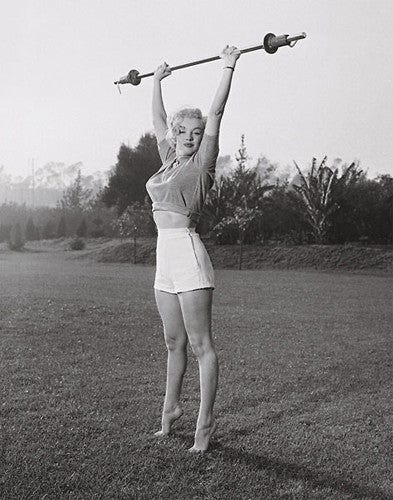
Contrary to outdated concerns that resistance training might adversely affect cardiovascular health, contemporary evidence demonstrates substantial cardioprotective effects. Women especially were encouraged not to lift weights, and that muscle was unattractive. Marilyn Monroe could easily have thrown a few plates on this barbell:
Regular strength training improves multiple cardiovascular disease risk factors, including blood pressure, lipid profiles, and arterial function. A comprehensive American Heart Association scientific statement concluded that 30-60 minutes per week of resistance training is associated with maximum cardiovascular risk reduction.
Regarding hypertension specifically, a systematic review of 14 randomized controlled trials found that strength training interventions lasting at least 8 weeks produced significant reductions in both systolic blood pressure (mean reduction: 10-12 mmHg) and diastolic blood pressure (mean reduction: 5-7 mmHg).
Mental Health and Cognitive Function
Lifting some weights, even if light weights, can change our brains. The mental health benefits of resistance training are real. A 2024 systematic review and meta-analysis demonstrated that resistance training produces meaningful reductions in both depression and anxiety symptoms, with effect sizes comparable to established treatments and pills. The benefits extend across diverse populations, including individuals with and without diagnosed mental health disorders.
Cognitive benefits are particularly notable in older adults. A landmark study found that six months of strength training protected hippocampal brain regions vulnerable to Alzheimer’s disease from degeneration, with protective effects persisting up to 12 months after training cessation. Resistance training improves executive function, memory, and processing speed in older adults, likely through multiple mechanisms including increased cerebral blood flow, neuroplasticity, and release of brain-derived neurotrophic factor (BDNF).
Practical Implementation and Safety Considerations
I kind of hate one-size-fits all prescriptions for exercise, especially the ones that stipulate minutes and reps. If all you take from this post is renewed interest in resistance training, a plan to talk to your doctor about what they think is safe for you to start, a renewed commitment to weights plus cardio, a fascination with muscle as more than just muscle, and an indelible photo of Marilyn Monroe — then it will have been worth the effort it took to share this with you.
Safety Profile: Resistance training has a favorable safety profile when programs are appropriately designed and supervised. The most common adverse events are muscle soreness and minor musculoskeletal strain, typically resolving without intervention.

Special Populations: Modifications are necessary for certain populations:
Older adults: Start with lower intensities, emphasize balance components, and progress gradually.
Cardiovascular disease: While resistance training is beneficial for most cardiac patients, those with poorly controlled hypertension, recent acute coronary syndrome, or severe valvular disease require medical clearance and supervised programs.
Pregnancy: Continue or initiate resistance training with modifications as pregnancy progresses, avoiding supine positioning after 16 weeks while emphasizing core and pelvic floor integration.
Chronic conditions: Most chronic diseases benefit from resistance training, but program design should account for disease-specific limitations and symptoms (e.g., shortness of breath in COPD, fatigue in cancer survivors, etc).
Barriers and Solutions: Despite overwhelming evidence of benefit, only one third of US adults report meeting the twice-weekly resistance training recommendation. Primary care docs like me might address common barriers by:
Emphasizing that benefits occur with modest time commitments (30-60 minutes weekly). Consider this post the expanded conversation!
Clarifying that home-based programs using body weight, resistance bands, or modest equipment are effective. We should avoid the self-defeating trap of equating exercise only with a trek to the actual gym.
Addressing safety concerns with evidence that supervised, progressive programs are generally safe
Prescribing resistance training as medicine, with specific recommendations for frequency, exercises, and progression. I have updated the standard patient education paragraph I put in routine physical visit documentation.
Conclusion
The research is pretty compelling: resistance training isn’t just about looking good for Pete Hegseth or impressing anyone at the gym. It’s about building a foundation for everything else we want to do—from staying more active and engaged in life to maintaining our independence as we age. Whether we are doing pushups halfway down on our knees in our living rooms, lifting some light weights while watching Netflix after dinner, or following some version of a 7-minute bodyweight circuit between Office Space meetings, the key is simply getting started. Then staying consistent.
Our muscles are waiting patiently, but they won’t wait forever. They don’t care if we’re using fancy equipment or soup cans. They just want to work against something. Resistance feels good in many ways. So pick a routine that doesn’t hurt, that you can actually stick with, that doesn’t feel too intense for your heart, and that fits into the life you’re already living. Talk to your doctor if you have concerns; listen to your body’s feedback.
I’m certainly not a weight lifting guru, but in my prime I could bench a good amount, and once dunked a small basketball. Ok, it rattled around the rim for a while, but it definitely went in.
The best resistance training program is the one you’ll actually do.
Start there?
To read more from Ryan McCormick, M.D.
P.S. If you found this post helpful, would you please consider restacking it and sharing it with your audience?
To read preview chapters of Rick’s forthcoming book, The Wilds of Cancer: A Life-Affirming Journey

Click the button to subscribe to Rick’s Substack for free. I hope you join me on this journey, and I welcome your comments and feedback.
Excellent advice!
Filing this for reference for my next post on fitness after prostate cancer